
【Kotlin】集合
https://kotlinlang.org/docs/collections-overview.html
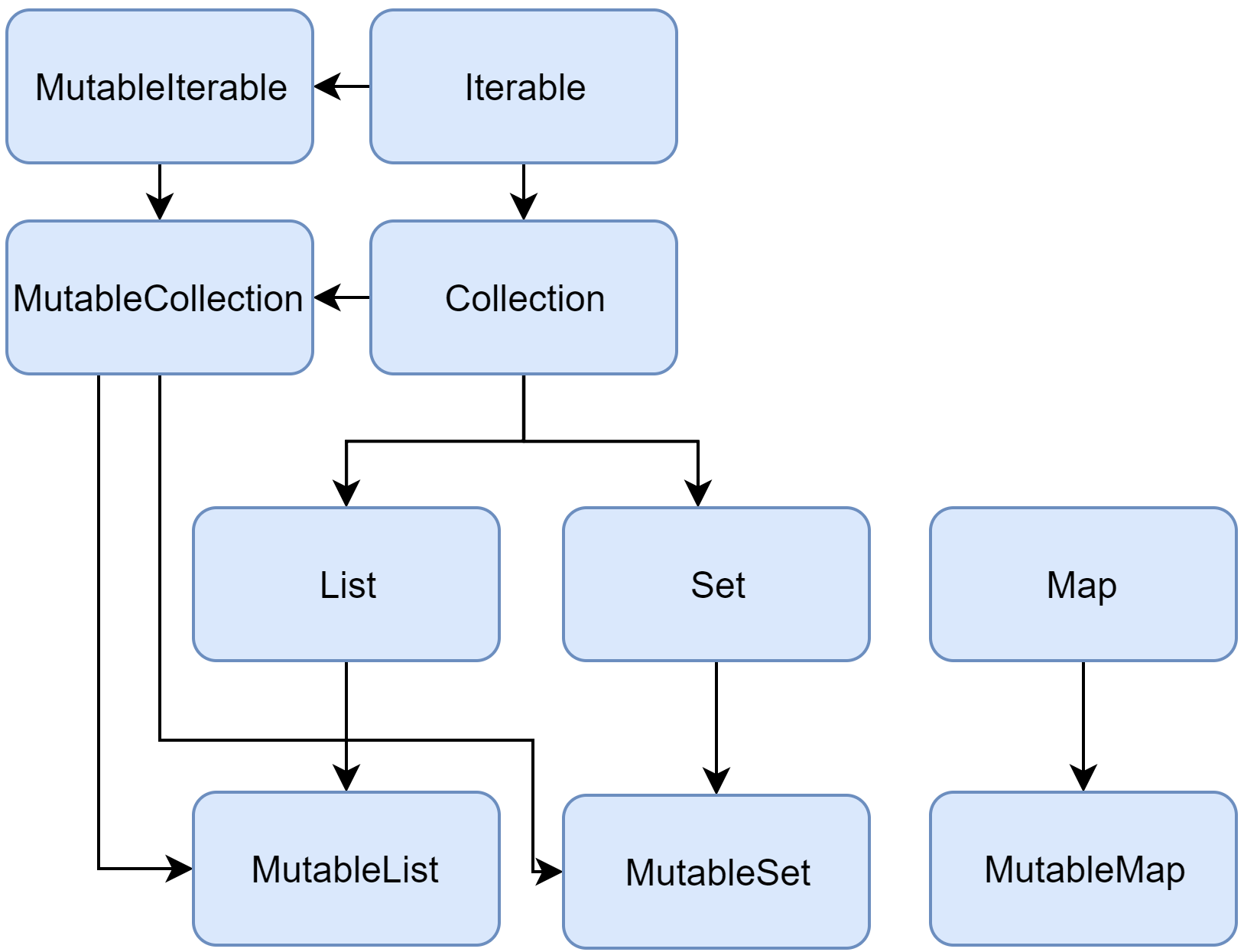
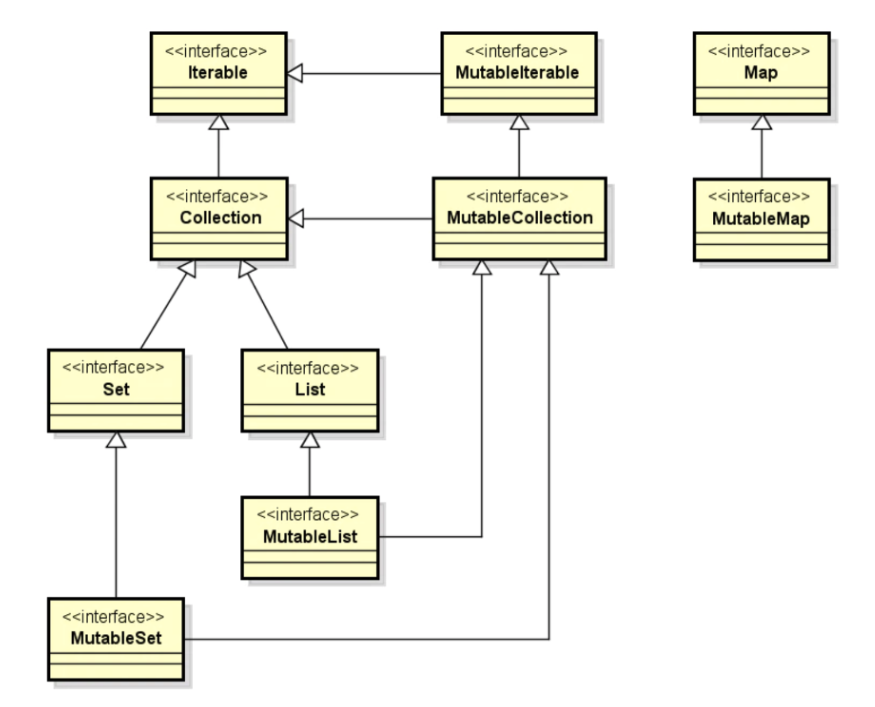
Creating Collections
|
Arrays
|
Simple Array
val intArray: Array<Int> = arrayOf(1, 2, 3)Simple Array of Primitives
val primitiveIntArray: IntArray = intArrayOf(1, 2, 3)Or
doubleArrayOf(1,2,3) / longArrayOf(1,2,3) / floatArrayOf(1,2,3) etc.Copy of Array
val copyOfArray: Array<Int> = intArray.copyOf()Partial copy of Array
val partialCopyOfArray: Array<Int> = intArray.copyOfRange(0, 2)Lists
Simple List
val intList: List<Int> = listOf(1, 2, 3)Or
arrayListOf(1,2,3)Empty List
val emptyList: List<Int> = emptyList()Or
listOf()List with no null elements
val listWithNonNullElements: List<Int> = listOfNotNull(1, null, 3)same as
List(1,3)Sets
Simple Set
val aSet: Set<Int> = setOf(1)Or
hashSetOf(1) / linkedSerOf(1)Empty Set
val emptySet: Set<Int> = emptySet()Or
setOf() / hashSetOf() / linkedSetOf()Maps
Simple Map
val aMap: Map<String, Int> = mapOf("hi" to 1, "hello" to 2)Or
mapOf(Pair("hi", 1) / hashMapOf("hi" to 1) / linkedMapOf("hi" to 1)Empty Map
val emptyMap: Map<String, Int> = emptyMap()Or
mapOf() / hashMapOf() / linkedMapOf()Black sheep, mutables
Simple Mutable List
val mutableList: MutableList<Int> = mutableListOf(1, 2, 3)Simple Mutable Set
val mutableSet: MutableSet<Int> = mutableSetOf(1)Simple Mutable Map
var mutableMap: MutableMap<String, Int> = mutableMapOf("hi" to 1, "hello" to 2)We will be using these collections throughout the cheat sheet.
Operators
|
Method
|
Example
Result
Explanation
Iterables
Plus
intList + 1[1, 2, 3, 1]Returns a new iterables with old values + added one
Plus (Iterable)
intList + listOf(
1, 2, 3)
[1, 2, 3, 1, 2, 3]Returns a new iterable with old values + values from added iterable
Minus
intList - 1[2, 3]Returns a new iterable with old values - subtracted one
Minus (Iterable)
intList - listOf(1, 2)[3]Returns a new iterable with old values without the values from subtracted iterable
Maps
Plus
aMap + Pair("Hi", 2){hi=1, hello=2, Goodbye=3}Returns new map with old map values + new Pair. Updates value if it differs
Plus (Map)
aMap + mapOf(
Pair("hello", 2), Pair("Goodbye", 3)){hi=1, hello=2, Goodbye=3}Returns new map with old map values + Pairs from added map. Updates values if they differ.
Minus
aMap - Pair("Hi", 2){Hi=2}Takes in a key and removes if found
Minus (Map)
aMap - listOf("hello", "hi"){}Takes in an iterable of keys and removes if found
Mutables
Minus Assign
mutableList -= 2[1, 3]Mutates the list, removes element if found. Returns boolean
Plus Assign
mutableList += 2[1, 3, 2]Mutates the list, adds element. Returns boolean
Minus Assign (MutableMap)
mutableMap.minusAssign("hello"){hi=1}Takes in key and removes if that is found from the mutated map. Returns boolean. Same as
-=Plus Assign (MutableMap)
mutableMap.plusAssign("Goodbye" to 3){hi=1, Goodbye=3}Takes in key and adds a new pair into the mutated map. Returns boolean. Same as
+=Transformers
|
Method
|
Example
Result
Explanation
Associate
intList.associate {
Pair(it.toString(), it)
}{1=1, 2=2, 3=3}Returns a Map containing key-value pairs created by lambda
Map
intList.map { it + 1 }[2,3,4]Returns a new list by transforming all elements from the initial Iterable.
MapNotNull
intList.mapNotNull { null }[]Returned list contains only elements that return as not null from the lamdba
MapIndexed
intList.mapIndexed{ idx, value ->
if (idx == 0) value + 1 else value + 2
}[2,4,5]Returns a new list by transforming all elements from the initial Iterable. Lambda receives an index as first value, element itself as second.
MapIndexedNotNull
intList.mapIndexedNotNull { idx, value ->
if (idx == 0) null else value + 2
}[4,5]Combination of Map, MapIndexed & MapIndexedNotNull
MapKeys
aMap.mapKeys { pair -> pair.key + ", mate" }{hi, mate=1, hello, mate=2}Transforms all elements from a map. Receives a Pair to lambda, lamdba return value is the new key of original value
MapValues
aMap.mapValues { pair -> pair.value + 2 }){hi=3, hello=4}Transforms all elements from a map. Receives a Pair to lambda, lamdba return value is the new value for the original key.
Reversed
intList.reversed())[3,2,1]Partition
intList.partition { it > 2 })Pair([3], [1,2])Splits collection into to based on predicate
Slice
intList.slice(1..2))[2,3]Takes a range from collection based on indexes
Sorted
intList.sorted())[1,2,3]SortedByDescending
intList.sortedByDescending { it }[3,2,1]Sorts descending based on what lambda returns. Lamdba receives the value itself.
SortedWith
intList.sortedWith(Comparator<Int> { x, y ->
when {
x == 2 -> 1
y == 2 -> -1
else -> y - x
}
})[3,1,2]Takes in a Comparator and uses that to sort elements in Iterable.
Flatten
listOf(intList, aSet).flatten()[2,3,4,1]Takes elements of all passed in collections and returns a collection with all those elements
FlatMap with just return
listOf(intList, aSet).flatMap { it }[2,3,4,1]Used for Iterable of Iterables and Lambdas that return Iterables. Transforms elements and flattens them after transformation.
FlatMap with transform
listOf(intList, aSet).flatMap {
iterable: Iterable<Int> ->
iterable.map { it + 1 }
}[2,3,4,2]FlatMap is often used with monadic containers to fluently handle context, errors and side effects.
Zip
listOf(3, 4).zip(intList)[(3,1), (4,2)]Creates a list of Pairs from two Iterables. As many pairs as values in shorter of the original Iterables.
Zip with predicate
listOf(3, 4).zip(intList) {
firstElem, secondElem ->
Pair(firstElem - 2, secondElem + 2)
}[(1,3), (2,4)]Creates a list of Pairs from two Iterables. As many pairs as values in shorter of the original Iterables. Lambda receives both items on that index from Iterables.
Unzip
listOf(Pair("hi", 1), Pair("hello", 2)).unzip()Pair([hi, hello], [1,2])Reverses the operation from
zip. Takes in an Iterable of Pairs and returns them as a Pair of Lists.Aggregators
|
Method
|
Example
Result
Explanation
Folds And Reduces
Fold
intList.fold(10) { accumulator, value ->
accumulator + value
}16 (10+1+2+3)Accumulates values starting with initial and applying operation from left to right. Lambda receives accumulated value and current value.
FoldIndexed
intList.foldIndexed(10) { idx, accumulator, value ->
if (idx == 2) accumulator else accumulator + value }13 (10+1+2)Accumulates values starting with initial and applying operation from left to right. Lambda receives index as the first value.
FoldRight
intList.foldRight(10) { value, accumulator ->
accumulator + value
}16 (10+3+2+1)Accumulates values starting with initial and applying operation from right to left. Lambda receives accumulated value and current value.
FoldRightIndexed
intList.foldRightIndexed(10) { idx, value, accumulator ->
if (idx == 2) accumulator else accumulator + value
}16 (10+3+2+1)Reduce
intList.reduce { accumulator, value ->
accumulator + value
}6 (1+2+3)Accumulates values starting with first value and applying operation from left to right. Lambda receives accumulated value and current value.
ReduceRight
intList.reduceRight { value, accumulator ->
accumulator + value
}6 (3+2+1)Accumulates values starting with first value and applying operation from right to left. Lambda receives accumulated value and current value.
ReduceIndexed
intList.reduceIndexed { idx, accumulator, value ->
if (idx == 2) accumulator else accumulator + value
}3 (1+2)ReduceRightIndexed
intList.reduceRightIndexed { idx, value, accumulator ->
if (idx == 2) accumulator else accumulator + value
}3 (2+1)Grouping
GroupBy
intList.groupBy { value -> 2 }{2=[1, 2, 3]}Uses value returned from lamdba to group elements of the Iterable. All values whose lambda returns same key will be grouped.
GroupBy (With new values)
intList.groupBy({ it }, { it + 1 }){1=[2], 2=[3], 3=[4]}Same as group by plus takes another lambda that can be used to transform the current value
GroupByTo
val mutableStringToListMap = mapOf("first" to 1,
"second" to 2)
mutableStringToListMap.values.groupByTo(
mutableMapOf<Int, MutableList<Int>>(), {
value: Int -> value }, { value -> value + 10 }){1=[11], 2=[12]}
Group by first lambda, modify value with second lambda, dump the values to given mutable map
GroupingBy -> FoldTo
intList.groupingBy { it }
.foldTo(mutableMapOf<Int, Int>(), 0) {
accumulator, element ->
accumulator + element
}{1=1, 2=2, 3=3}Create a grouping by a lambda, fold using passed in lambda and given initial value, insert into given mutable destination object
Grouping > Aggregate
intList.groupingBy { "key" }
.aggregate({
key, accumulator: String?,
element, isFirst ->
when (accumulator) {
null -> "$element"
else -> accumulator + "$element"
}
}){key=123}Create a grouping by a lambda, aggregate each group. Lambda receives all keys, nullable accumulator and the element plus a flag if value is the first on from this group. If isFirst --> accumulator is null.
Chunked
val list = listOf("one", "two", "three", "four", "five", "six", "seven", "eight", "nine", "ten")

list.chunked(3)
[[one, two, three],
[four, five, six],
[seven, eight, nine],
[ten]]Splits this collection into a list of lists each not exceeding the given size
The last list in the resulting list may have less elements than the given size.
The last list in the resulting list may have less elements than the given size.
Aggregating
Count
intList.count()3AKA size
Count (with Lambda)
intList.count { it == 2 })1Count of elements satisfying the predicate
Average
intList.average()2.0 ((1+2+3)/3 = 2.0)Only for numeric Iterables
Max
intList.max()3Maximum value in the list. Only for Iterables of Comparables.
MaxBy
intList.maxBy { it * 3 }3Maximum value returned from lambda. Only for Lambdas returning Comparables.
MaxWith
intList.maxWith(oneOrLarger)1Maximum value defined by passed in Comparator
Min
intList.min()1Minimum value in the list. Only for Iterables of Comparables.
MinBy
intList.minBy { it * 3 }1Minimum value returned from lambda. Only for Lambdas returning Comparables.
MinWith
intList.minWith(oneOrLarger)3Minimum value defined by passed in Comparator
Sum
intList.sum()6Summation of all values in Iterable. Only numeric Iterables.
SumBy
intList.sumBy { if(it == 3) 6 else it })9 (1+2+6)Summation of values returned by passed in lambda. Only for lambdas returning numeric values.
SumByDouble
intList.sumByDouble { it.toDouble() }6.0Summation to Double values. Lambdareceives the value and returns a Double.
val oneOrLarger = Comparator<Int> { x, y ->
when{
x == 1 -> 1
y == 1 -> -1
else -> y - x
}
}
when{
x == 1 -> 1
y == 1 -> -1
else -> y - x
}
}
Filtering and other predicates + getting individual elements
|
Method
|
Example
Result
Notes
Filtering
Filter
intList.filter { it > 2 }[3]Filter-in
FilterKeys
aMap.filterKeys { it != "hello" }{hi=1}FilterValues
aMap.filterValues { it == 2 }{hello=2}FilterIndexed
intList.filterIndexed { idx, value ->
idx == 2 || value == 2
}[2,3]FilterIsInstance
intList.filterIsInstance<String>()[]Type parameter defines the class instance. None returned because in our list all of them are ints
Taking and Dropping
Take
intList.take(2)[1,2]Take n elements from Iterable. If passed in number larger than list, full list is returned.
TakeWhile
intList.takeWhile { it < 3 }[1,2]TakeLast
intList.takeLast(2)[2,3]TakeLastWhile
intList.takeLastWhile { it < 3 }[]Last element already satisfies this condition --> empty
Drop
intList.drop(2)[3]Drop n elements from the start of the Iterable.
DropWhile
intList.dropWhile { it < 3 }[3]DropLast
intList.dropLast(2)[1]DropLastWhile
intList.dropLastWhile { it > 2 }[1, 2]Retrieving individual elements
Component
intList.component1()1There are 5 of these -->
component1(), component2(), component3(), component4(), component5()ElementAt
intList.elementAt(2)3Retrieve element at his index. Throws IndexOutOfBounds if element index doesn't exist
ElementAtOrElse
intList.elementAtOrElse(13) { 4 }4Retrieve element at his index or return lambda value if element index doesn't exist.
ElementAtOrNull
intList.elementAtOrNull(666)nullRetrieve element at his index or return null if element index doesn't exist.
Get (clumsy syntax)
intList.get(2)3Get element by index
Get
intList[2]3Shorthand and preferred way for the one above
GetOrElse
intList.getOrElse(14) { 42 }42Get element or return lambda value if it doesn't exist.
Get from Map (clumsy syntax)
aMap.get("hi")1Get from Map
aMap["hi"]1GetValue
aMap.getValue("hi")11Get value or throw NoSuchElementException
GetOrDefault
aMap.getOrDefault("HI", 4)4Get value or return the value returned from lambda
GetOrPut
mutableMap.getOrPut("HI") { 5 }5MutableMap only. Returns the the value if it exist, otherwise puts it and returns put value.
Finding
BinarySearch
intList.binarySearch(2)1Does a binary search through the collection and returns the index of the element if found. Otherwise returns negative index.
Find
intList.find { it > 1 }2First element satisfying the condition or null if not found
FindLast
intList.findLast { it > 1 }3Last element satisfying the condition or null if not found
First
intList.first()1First element of Iterable or throws NoSuchElementException
First with predicate
intList.first { it > 1 }2Same as find but throws NoSuchElementException if not found
FirstOrNull
intList.firstOrNull()1Throw safe version of
first().FirstOrNull with predicate
intList.firstOrNull { it > 1 }2Throw safe version of
first(() -> Boolean).IndexOf
intList.indexOf(1)0IndexOfFirst
intList.indexOfFirst { it > 1 }1IndexOfLast
intList.indexOfLast { it > 1 }2Last
intList.last()3Throws NoSuchElementException if empty Iterable
Last with predicate
intList.last { it > 1 }3Throws NoSuchElementException if none found satisfying the condition.
LastIndexOf
intList.lastIndexOf(2)1LastOrNull
intList.lastOrNull()3Throw safe version of
last()LastOrNull with predicate
intList.lastOrNull { it > 1 }3Throw safe version of
last(() -> Boolean).Unions, distincts, intersections etc.
Distinct
intList.distinct()[1, 2, 3]DistinctBy
intList.distinctBy { if (it > 1) it else 2 }[1,3]Intersect
intList.intersect(listOf(1, 2))[1,2]MinusElement
intList.minusElement(2)[1,3]MinusElement with collection
intList.minusElement(listOf(1, 2))[3]Single
listOf("One Element").single()One ElementReturns only element or throws.
SingleOrNull
intList.singleOrNull()null
Throw safe version of
single().OrEmpty
intList.orEmpty()[1, 2, 3]Returns itself or an empty list if itself is null.
Union
intList.union(listOf(4,5,6))[1,2,3,4,5,6]Union (infix notation)
intList union listOf(4,5,6)[1,2,3,4,5,6]Checks and Actions
|
Method
|
Example
Result
Notes
Acting on list elements
val listOfFunctions = listOf({ print("first ") }, { print("second ") })ForEach
listOfFunctions.forEach { it() }first secondForEachIndexed
listOfFunctions.forEachIndexed { idx, fn ->
if (idx == 0) fn() else print("Won't do it")
}first Won't do itOnEach
intList.onEach { print(it) }123Checks
All
intList.all { it < 4 }trueAll of them are less than 4
Any
intList.any()trueCollection has elements
Any with predicate
intList.any { it > 4 }falseNone of them are more than 4
Contains (standard)
intList.contains(3)trueContains (idiomatic Kotlin)
3 in intListtrueContainsAll
intList.containsAll(listOf(2, 3, 4))falseContains (Map, standard)
aMap.contains("Hello")falseSame as
containsKey()Contains (Map, Idiomatic Kotlin)
"Hello" in aMapfalseSame as
containsKey()ContainsKey
aMap.containsKey("hello")trueSame as
contains()ContainsValue
aMap.containsValue(2)trueNone
intList.none()falseThere are elements on the list
None with predicate
intList.none { it > 5 }trueNone of them are larger than 5
IsEmpty
intList.isEmpty()falseIsNotEmpty
intList.isNotEmpty()true